Travel to Greece
Day 3 Cape Sounion - Athens (85 Km.)
Athens: On our second day in Athens we started visiting its Acropolis. The acropolis was literally the high city and was present in most Greek cities, with a double function: defensive and as the seat of the main places of worship. The one in Athens is located on a top, which rises 156 meters above sea level. We access the site by the entrance of the southern slope. The first great building we see is the Theatre of Dionysus, which was the largest theater in ancient Greece. Its measurements are 117.9 cm high and 96.09 cm wide. The initial construction is from the second half of the sixth century BC. The stands or koilon had 78 rows, divided into two levels by a circular corridor. In the central and last part of the first stands there were 67 seats that were subsequently made in decorated marble and were reserved for dignitaries. In its final stage it had capacity for 15,000-17,000 spectators.
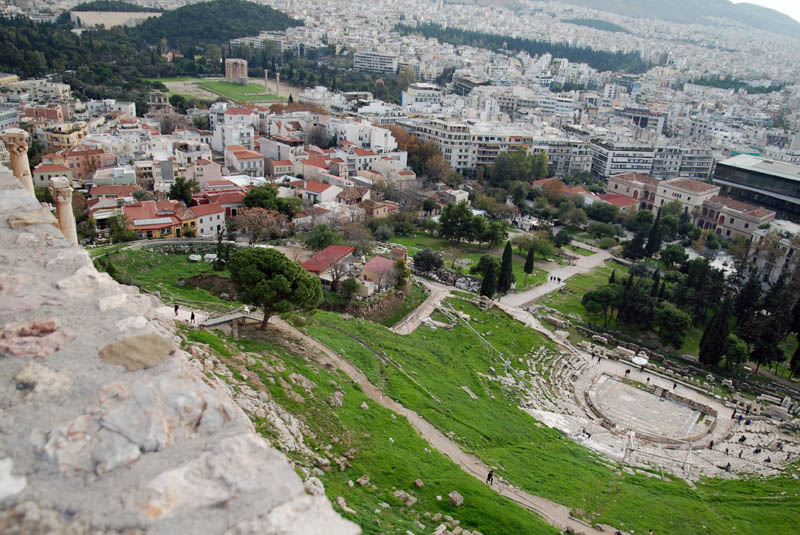
Athens - Theatre of Dionysus
We continue ascending the Acropolis hill until we reach the Odeon of Herodes Atticus, a building for musical auditions, erected in the year 161 thanks to the great fortune of the Roman consul Herod Attic, who had it built in memory of his dead wife the previous year. It was located next to the Theatre of Dionysus. Its floor is similar to that of a Roman theater, with the difference that the odeon was covered. It was rather small, had a capacity in its stands for five thousand spectators. The stage was white marble and cipollino (a type of marble) and had a length of 35 meters. The Odeon was destroyed in the year 267, as a result of the invasion of the Heruli. Unlike other buildings that suffered damage, it was never rebuilt. The building was restored in 1952-1953. Since 1957 it hosts various artistic shows, such as concerts, theater, operas and dance shows.

Athens - Odeon of Herodes Atticus
After passing through the Beulé gate, we arrive at the Propylaea, the monumental entrance to the Acropolis of Athens. They were built from 437 BC by the architect Mnesicles in a rugged terrain The six columns of the entrance are Doric, the same as those in the front façade and the six in the back. It is built with pentelic marble, consists of a 24 x 18 meter lobby. Inside, a wall with five doors divides it into two parts; the western one, larger, has two rows of three Ionic columns that form three naves. To the right of the Propylaea we find the Temple of Athena Nike (Nike means "victory" in Greek), The construction commissioned to the architect Calicrates dates from the year 421 BC and 410 BC. The naos consists of an almost square plant of 418 cm x 3178 cm, with the pronaos of four columns and four more in the opistodoms, all of Ionic order. The frieze that runs through the entire temple had a decoration alluding to the Greco-Persian Wars, with the pediments dedicated to the goddess Athena. In the parapet of the bastion was added in the year 410 BC a decoration with large reliefs, where the school of Phidias is appreciated. The current temple is a reconstruction carried out in the years 1936 to 1940.
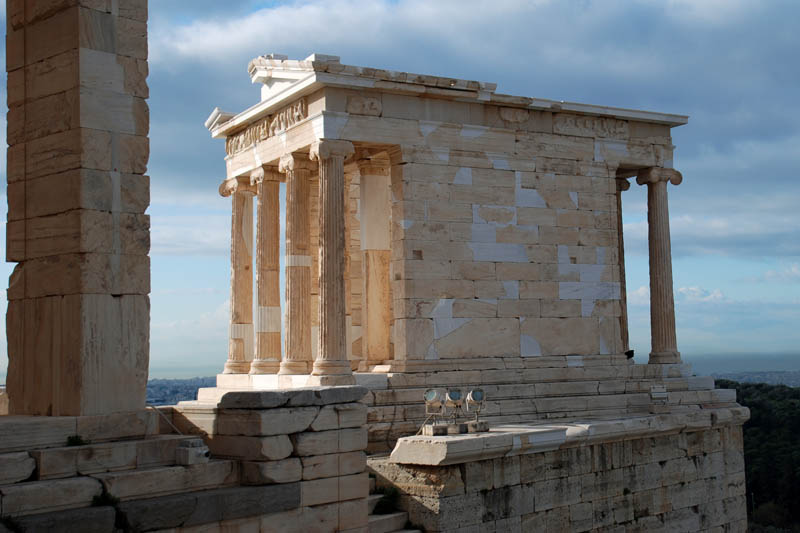
Athens - Temple of Athena Nike
Finally we arrive at the Parthenon, the temple dedicated to the protector of Athens, Athena Parthenos, and one of the main Octastyle Doric temples, somewhat rare, of white pentelic marble and covered with Paros marble tiles, which are preserved. It was built between 447 BC and 432 BC. It is the oldest monument of those located in the acropolis, built by order of Pericles under the supervision of Phidias. Together with the rest of the group that makes up the acropolis, the Parthenon was declared by UNESCO as a "World Heritage Site" in 1987. It is an octastyl, the only one in all of Greece, with eight columns on the two shortest facades and 17 on the sides. It is also a peripteral - with columns all around its perimeter. And finally, it is also an amphiprostyl temple - a porch at each entrance, on the shorter sides. It also consists of a double cell with pronaos and opistodom, but with prostyle with six-columns. Standing on a platform or stylobate of three steps, the approximate dimensions of the building are 69.5 meters long, 30.9 wide, with columns reaching 10.4 meters high. In the sixth century AD C., the Parthenon becomes a Christian church. After the Ottoman conquest, it becomes a mosque in the early 1460s, with its minaret. On September 26, 1687, a Turkish ammunition depot inside the building explodes because of the Venetian bombing. The resulting explosion severely damages the ensemble and its sculptures. In 1806, Thomas Bruce, count of Elgin, acquires some of the surviving sculptures, with the approval of the Ottomans, although causing damage to other elements during their extraction. These sculptures, known as the Elgin Marbles or the Parthenon Marbles, are sold in 1816 to the British Museum in London, where they are currently exhibited.

Athens - Parthenon
On the north side of the acropolis we find the Erechtheion, whose construction began in 421 BC. Of irregular plant, by the slope of the land, it consists of three porches. One of them, on the south face, is the famous Porch of the Caryatids, which indicated the tomb of the mythical King Kekrops. In the portico of the Caryatids six statues of draped young women, 2.3 meters high, serve as columns, supporting the entablature. Those found in situ are replicas. Five of the originals are in the Acropolis Museum, protected from corrosion and pollution, and the other in the British Museum in London. The Erechtheion is formed by a central building with an irregular floor plan, suitable for the uneven terrain, which comprises two parts without communication between them: to the east is a sanctuary dedicated to Athena of the hexatile type, with columns of Ionic order; To the west it is formed by two chapels with double worship: one to Erechtheum and Poseidon and the other to Hephaestus and Boutos.
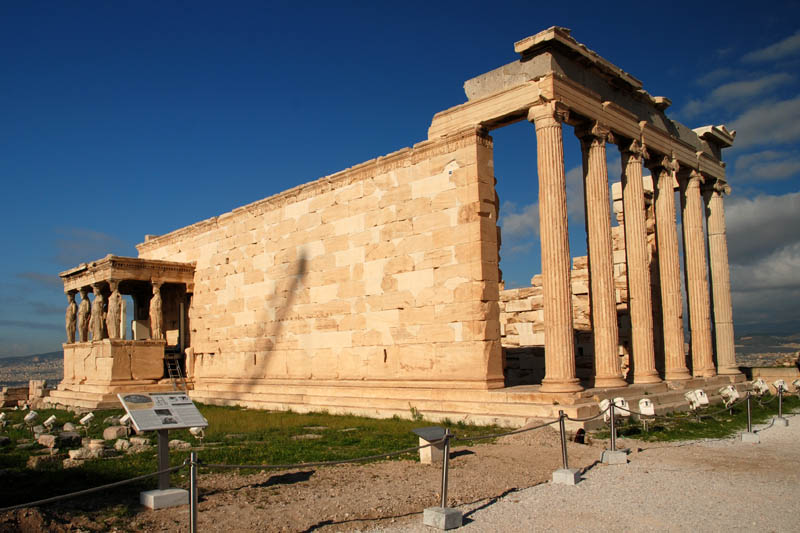
Athens - Erechtheion and Porch of the Caryatids
We descend from the Acropolis hill to go to the ancient agora. The agora of Athens was the center of the political, administrative, commercial and social activity of ancient Athens, its religious and cultural focus, and the place of justice. It was a wide open space, approximately rectangular, flanked by an accumulation of public buildings. The first political-religious buildings, located along the west side of the Agora, date from the early 6th century BC. During the Persian invasion of 480-479 BC, the Agora was destroyed, after the end of the Persian Wars, large-scale reconstruction was carried out, with the addition of new monumental works, especially from the time of Cimon (479 - 461 BC), especially with the construction of grandiose stoas of multiple uses, located on the perimeter of the Agora, and also with the erection of the temple of Hephaestion. Entering the Agora through the Panathenaic Way, the first building that was found was the Stoa Basileios, one of the oldest in the polis. Immediately afterwards another portico was raised, the Stoa of Zeus. The first civil buildings were the Stoa Poikile and the Tholos (465 BC), a circular building, seat of the 50 Prytaneis (executives) of the Boule.

Athens - Temple of Hephaestus on the ancient agora
The Temple of Hephaestus or Hephaisteion is located in the northwest of the Agora of Athens, on the top of the Agoraios Kolonos hill. It is a Doric peripteral and hexastyle temple, which shows visitors a particular wealth of sculptured ornaments. It retains the gable roof, with a pediment that no longer contains any ornament. The construction of the temple began in 449 BC, but it was not finished until the year 415 BC. It is one of the best preserved temples in Greece. The dimensions of the temple are 13,708 m from north to south, and 31,776 m from east to west, with six columns on the east and west facades, and thirteen in the north and south. The building consists of a pronaos, a cella (main room of worship of the images of the divinities) and an opistodom. In addition, it has an interior Doric colonnade with five columns on the north and south sides, and three on the sides. The material used was pentelic marble, except the first step of the crepidoma, which is of limestone, and the decorative sculptures, for which Paros marble, of higher quality, was chosen.

Athens - Hadrian´s Library on the Roman agora
The Roman Agora, established under Roman domination, is located a little east of the ancient Agora and to the north of the Acropolis of Athens, in the current Plaka neighborhood. It was built under the Roman emperor Augustus, between the years 19 BC and 11 BC, and enlarged by Hadrian, philhellene emperor. The loss of all political significance determined a progressive invasion of the agora by new structures, such as statues or commemorative elements. Then, progressively, in the course of the Byzantine and Ottoman periods, a whole neighborhood of houses, workshops and churches was built, along with the Fethiye Mosque. The area was excavated in the 19th century, demolishing modern buildings. Among its most outstanding monuments are the Gate of Athena Archegetis, the Hadrian´s Library (or the Hundred Columns Library), built in 132, and the Tower of the Winds, from the 2nd century BC, which was an octagonal public clock built with white marble from Mount Pentelicus. At the top of each of its eight sides there is a relief that represents a wind.

Athens - Monastiraki
Monastiraki Monastiraki is a neighborhood and open-air market in the old town of Athens and one of the main shopping districts in this city. The area owes its name to the Monastiraki square, which in turn bears the name of the Byzantine church of Pantanassa, which is located within the square. The main streets in this area are the Pandrossou and the Adrianou. The area is home to clothing stores, souvenir shops and specialty stores, and is a major tourist attraction in Athens and Attica for shopping businesses, as well as having many restaurants. In the square there is also the Ottoman mosque of Tzistarakis, right next to the Hadrian´s Library. It is a very lively square that also offers wonderful views of the acropolis.
(in 152 Km.) Lebadea: We slept in this town on our way to Delphi and Meteora.